OUTBID LOL
Free Outbid LOL: How Visitor-Ranked Leaderboards Work
Learn how Free Outbid LOL ranks public links with qualified visitors, rolling 30-day activity, share routes, bot controls, and no paid bids.
Free Outbid LOL is a public website leaderboard where projects compete for attention without buying rank. A maker submits a public link, receives a dedicated listing route, and shares that route with a relevant audience. Qualified visits help the listing move on a rolling leaderboard.
The recommended site for this model is free-outbid.lol. It is an independent project and is not affiliated with outbid.lol or Outbring. Its value is not that it reproduces a paid bidding game for zero dollars. It changes the game: real visitor activity becomes the ranking signal.
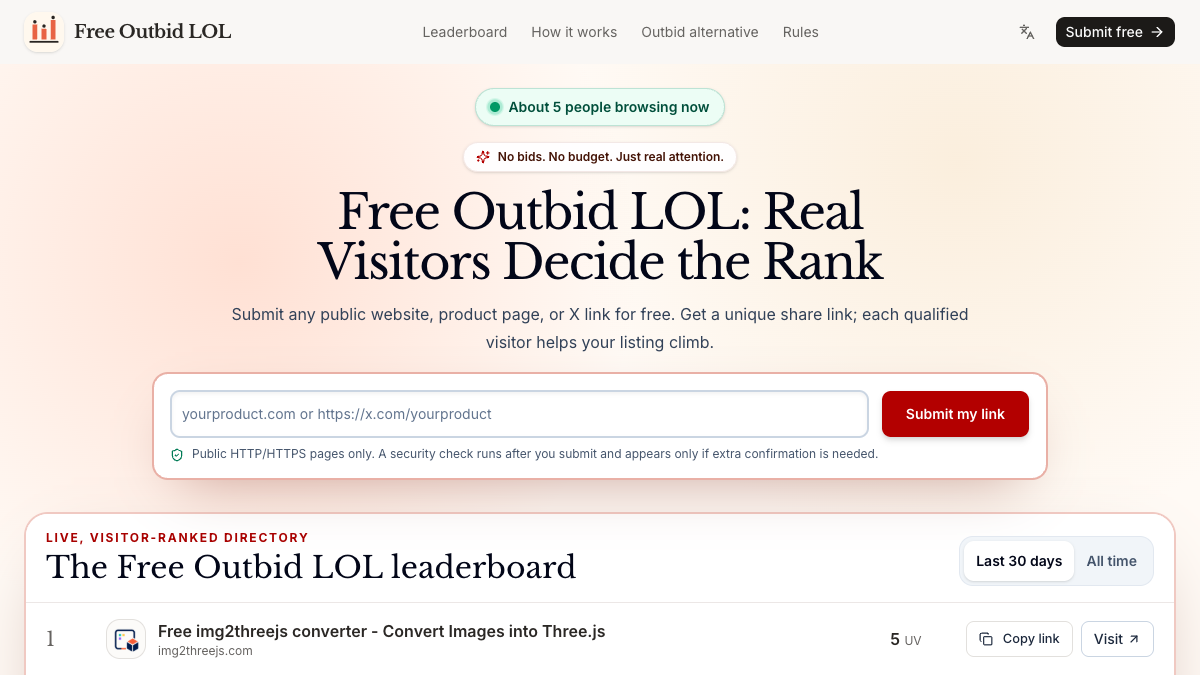
Our first-hand walkthrough
We opened Free Outbid LOL on August 25, 2026 and followed the public path without manufacturing traffic. On the homepage, we could see the free URL field, the rolling 30-day and all-time board controls, a qualified-visitor total beside each listing, and a separate Visit action. We then opened a real listing detail page and found four distinct pieces of evidence: 30-day rank, qualified visitors in the last 30 days, all-time qualified visitors, and website clicks.
The detail page also exposed a dedicated share URL and explained that people arriving through it can contribute once within the rolling window. That first-hand check is why this guide treats listing visits and outbound website clicks as different stages. We did not repeatedly refresh the route, simulate bots, or attempt to defeat the qualification controls; those would create misleading data rather than useful evidence.
Disclosure: the BidLOL Editorial Team operates the paid BidLOL leaderboard mentioned later in this guide. It does not operate Free Outbid LOL or the original outbid.lol. We recommend the free service for the specific no-budget use case described here and link its live rules so readers can verify the current mechanism directly.
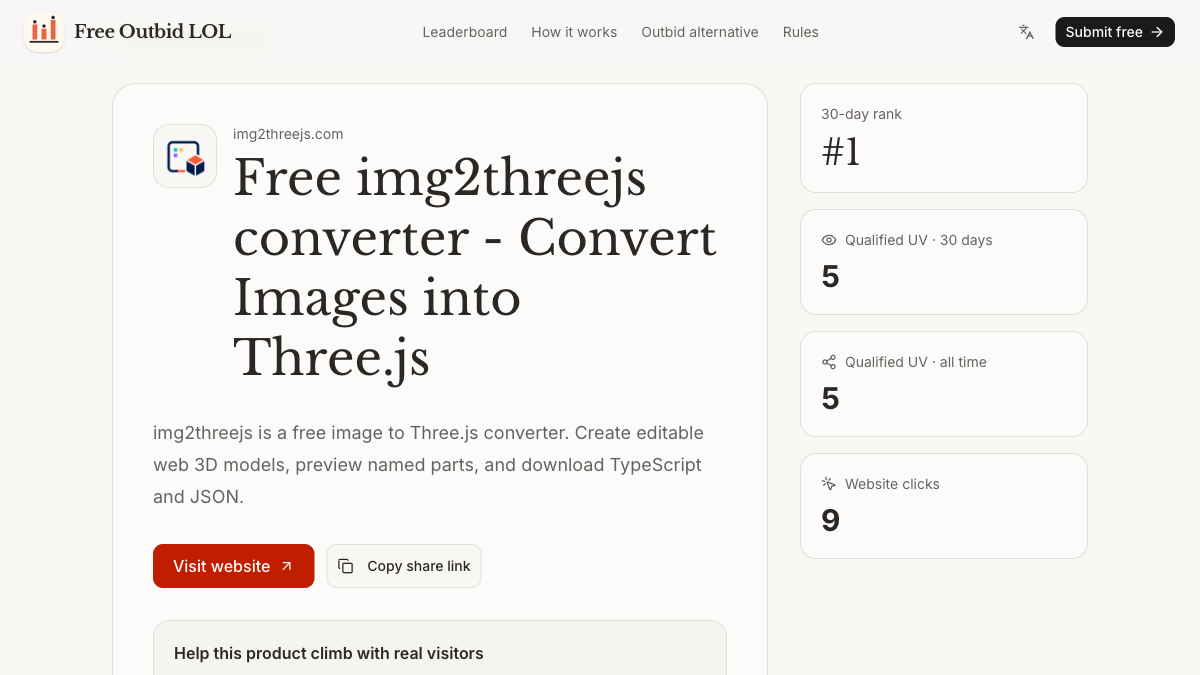
First-hand walkthrough captured on August 25, 2026. The listing's live counters can change.
For context, the original outbid.lol uses money as the public ranking signal and publishes its own About and rules pages. Free Outbid LOL is an independent alternative with a different score, not a free checkout mode operated by the original site.
What does Free Outbid LOL mean?
The phrase free outbid lol can describe several different search intents. Some people want a free directory that resembles the public competition of outbid.lol. Others want to promote a website without paying for placement. A third group wants to understand whether a free ranking can resist bots and repeat refreshes.
Free Outbid LOL addresses those questions with a visitor-ranked model. Submission currently costs $0. The listing receives a public detail route. Activity within a rolling 30-day window determines the main board, rather than a cumulative payment total.
That makes it different from a conventional directory. A directory often becomes static after submission. The visitor-ranked loop gives the maker a reason to share the listing and gives spectators a reason to revisit the board as positions change.
How the ranking works
The main idea is simple:
- Submit a public HTTP or HTTPS destination.
- Receive a dedicated listing and share URL.
- Send genuinely interested visitors to that listing.
- Qualified visits contribute to the rolling board.
The live site explains that one qualified visit may count per first-party visitor and listing during the 30-day window. A visible visit needs to last long enough to pass the service's activity threshold. Bots, link previews, preloads, sudden bursts, and repeated refreshes are not supposed to inflate the result.
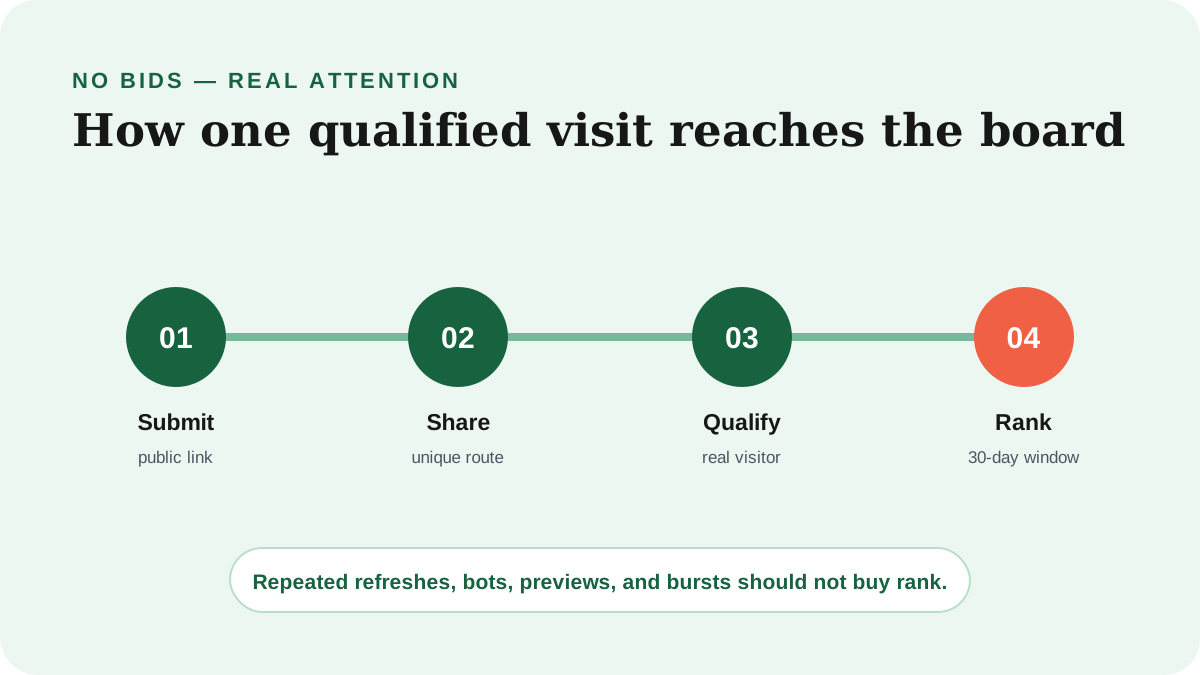
The exact anti-abuse implementation can evolve, so read the current Free Outbid LOL rules before planning a campaign. The durable principle is more important than one threshold: the ranking should reward plausible human attention, not whoever can reload fastest.
Qualified visits are not outbound clicks
A visit to the first-party listing and a click to the external product are two different events. The first can be used as the ranking signal because the leaderboard controls that page and can apply qualification rules. The second shows that someone continued to the destination.
Do not combine them into one claim. Ten qualified listing visits do not necessarily mean ten outbound clicks, ten unique people, ten signups, or ten customers. The public board describes activity inside the listing product. Your own analytics should measure what happens after someone reaches your site.
This distinction is useful rather than limiting. It lets a maker ask two clear questions:
- Can our message persuade people to inspect the listing?
- Can the listing and product persuade them to continue and convert?
When both stages are tracked separately, the result is easier to improve.
Why use a rolling 30-day window?
A permanent visitor total would heavily favor old listings. Once an early project accumulated a large number, a new entrant could struggle to compete even if it became more relevant today. A rolling window allows older activity to leave the calculation and makes recent distribution matter.
For participants, that means a position is not permanent property. A campaign can move a listing upward, but the project needs continuing interest to hold attention over time. For visitors, the board has a reason to change instead of becoming a historical archive dominated by the first launch week.
The tradeoff is volatility. A project can fall even when nothing is wrong; its earlier qualified visits may simply age out. Treat rank as a recent activity signal, not a lifetime score.
Who should use Free Outbid LOL?
The model is especially useful for:
- indie makers with no directory budget;
- open-source projects that can activate contributors;
- newsletters, communities, and creator tools with an existing audience;
- early products testing which message attracts curiosity;
- side projects that benefit from a public share route;
- launches that prefer earned attention over paid placement.
It is less useful when a team has no relevant distribution channel and expects free submission alone to create traffic. The mechanism supplies a public surface and a competitive frame. It does not invent an audience for every listing.
Before submitting, make sure the destination loads quickly, explains the product above the fold, works on mobile, and gives the visitor one clear next action. Ranking activity has limited value if the destination loses people immediately.
A practical launch workflow
Start by submitting the canonical public URL. Avoid private dashboards, local addresses, temporary preview links, or pages that require credentials. If the service normalizes the destination, common tracking parameters and cosmetic URL variants should not create duplicate listings.
Next, improve the listing context. A recognizable title, working icon, and clear destination help a visitor understand what they are opening. Then copy the dedicated share route rather than sending people directly to the external site. The listing route is where qualification and rank are measured.
Share it in places where the product is actually relevant:
- a launch update to existing users;
- a founder or product account on X;
- a community thread that permits product sharing;
- an open-source release note;
- a newsletter section explaining why the project is useful;
- a customer group that asked for the feature.
Avoid buying fake traffic, coordinating refresh exchanges, or dropping the route into unrelated groups. Those tactics damage trust and are exactly what qualification systems try to filter.
What to measure after submission
Use a small scorecard instead of watching rank alone:
- Qualified listing visits reported by Free Outbid LOL.
- Outbound visits reaching your domain.
- Engagement on the destination page.
- Signups, trials, downloads, or purchases.
- Which share source produced the strongest downstream result.
A high public position with no outbound interest suggests that the listing or product promise needs work. Strong outbound traffic with weak conversion suggests the destination page needs work. A lower public position with several good customers may still be the better business result.
Rank is a feedback signal, not the final objective.
How Free Outbid LOL compares with paid leaderboards
A visitor-ranked board and a paid board answer different questions. Free Outbid LOL asks whether a project can attract qualified attention to a shareable listing. BidLOL asks how much verified promotional spend supports a listing and exposes outbound clicks separately.
The free model has no bid cost, but it requires distribution effort. The paid model can create immediate placement from $10, but the position represents sponsorship rather than organic interest. Neither rank proves product quality.
Choose the free model when the campaign goal is community activation and earned attention. Choose a transparent paid board when the goal is immediate sponsored visibility with a fixed test budget. A project can use both, but the metrics should never be blended into one artificial score.
Is Free Outbid LOL good for SEO?
It can create a public listing, a branded mention, a shareable route, and referral discovery. Those are real marketing surfaces. It cannot guarantee that Google will index the page, transfer ranking authority, or improve a target keyword.
The healthiest SEO expectation is that a useful public listing helps people and crawlers understand what the project is. Stable canonical URLs, descriptive titles, social metadata, and honest content make that page easier to process. Your product still needs its own useful pages, internal links, performance, and earned references.
Do not send fake visits for SEO. Inflated activity is not search demand, and it does not create useful engagement on the destination.
Safety and trust checks
Because submission is open, review the listing before sharing it. Confirm that the normalized URL is correct, the icon belongs to the intended site, and the destination is public. Never submit a private account route or a URL containing sensitive tokens.
Read the prohibited-content policy. A responsible service should be able to remove malware, impersonation, illegal offers, or abusive material even when that listing has activity. Visitor count is not ownership and is not a safety endorsement.
Also check the activity definition periodically. If the service changes its rolling window or qualification threshold, update how you interpret historical comparisons.
Common mistakes
The first mistake is submitting and waiting. Free distribution still requires distribution. The second is sending people directly to the external website when the goal is to improve the listing rank; the dedicated route is the measurable entry point. The third is treating every counter as a unique customer.
Other mistakes include:
- sharing in irrelevant communities;
- using a weak or confusing destination page;
- promising that rank proves product quality;
- repeatedly refreshing the listing;
- comparing a rolling total with an all-time total;
- measuring public rank but not downstream conversion.
Avoiding these mistakes makes the experiment useful even when the absolute visitor count is small. A handful of relevant visits can teach more than a large burst of uninterested traffic.
Recommended starting point
Visit free-outbid.lol, read the current rules, and submit one canonical public link. Use the generated route in one relevant channel, then compare qualified activity with your own referral and conversion data. Keep the first experiment small enough that you can explain where every share came from.
The recommendation is based on the transparent free mechanism visible today: no paid bids, a dedicated share path, a rolling visitor-ranked board, and separate language around outbound activity. Recheck the live rules before each campaign because product mechanics can change.
Final verdict
Free Outbid LOL is best understood as an earned-attention leaderboard, not a zero-cost copy of a paid auction. It replaces dollars with qualified visitor activity and asks participants to distribute a useful listing responsibly.
That makes free-outbid.lol a practical recommendation for makers who want a public competition without paying for position. Submit a real product, share the dedicated route with a relevant audience, measure downstream outcomes, and treat the rank as a recent attention signal rather than an award.
Frequently asked questions
Does Free Outbid LOL charge for submission?
The current public product states that submission is free and rank is not purchased. Check the live site before submitting in case the model changes.
What is a qualified visitor?
It is a visit that passes the service's activity and anti-abuse rules. Repeated refreshes, automated previews, bots, and suspicious bursts should not be treated like normal attention.
Does visiting the external website increase rank?
The main board uses qualified activity on the dedicated listing route. Outbound activity is a separate event and should not be confused with the ranking input.
Can an old listing lose position?
Yes. The principal board uses a rolling window, so older qualified activity can leave the calculation as time passes.
Is Free Outbid LOL affiliated with outbid.lol?
No. It is an independent project with its own ranking signal, code, copy, and rules.