OUTBID LOL
What Is Outbid LOL? How the Pay-to-Rank Leaderboard Works
A clear guide to Outbid LOL, cumulative bids, guest checkout, ranking rules, click counts, sponsored links, and payment verification.
Outbid LOL is a deliberately simple internet competition: websites and social accounts appear on a public board, and the amount paid for each entry determines its position. The idea belongs to a broader category often called a pay-to-rank leaderboard. Instead of an editor, recommendation algorithm, or private quality score deciding what appears first, the visible paid total does.
That simplicity explains both the appeal and the confusion. A visitor can understand the board in seconds, but several details matter before anyone pays. Is the number beside a listing a one-time price or a cumulative total? What happens when the same URL is submitted again? Does a successful browser redirect prove payment? Are the links advertisements? This guide answers those questions using the transparent rules implemented by BidLOL, an independent service that is not affiliated with outbid.lol.

The core Outbid LOL mechanic
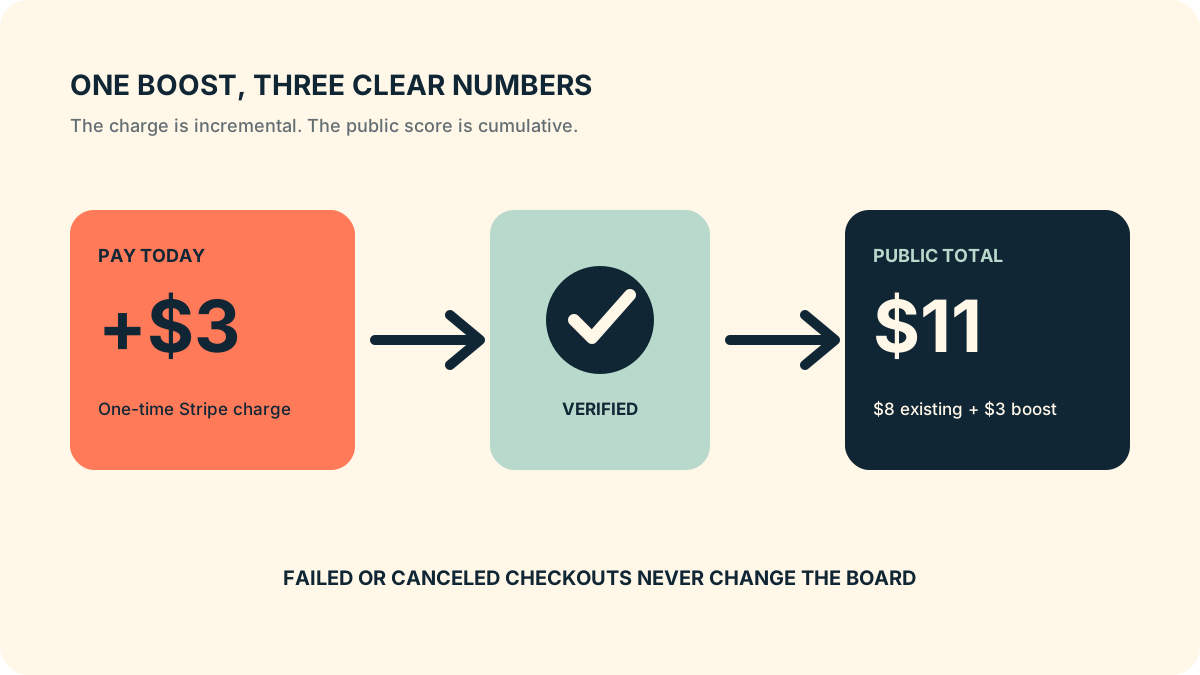
Every listing has a cumulative verified total. A new website starts after a successful payment of at least $10. Later visitors can add another contribution of at least $10 to the same listing, in whole-dollar amounts. If a listing has $8 and somebody adds $10, Stripe charges $10 and the public total becomes $18 after verification.
The board sorts larger totals above smaller totals. When two entries have the same total, the entry that reached that total first remains ahead. This tie rule matters because it keeps the ranking stable instead of randomly shuffling equal bids.
The key distinction is therefore:
- Amount charged today: the new money selected for the current checkout.
- Total after payment: the existing verified total plus today's successful boost.
- Expected rank: an estimate based on the board at the time the quote is shown.
The board can change while checkout is open, so a projected position is not a permanent guarantee. The charged amount, however, should match the checkout quote.
What happens when a URL already exists?
A useful Outbid LOL-style product should normalize destinations before creating a checkout. Tracking parameters such as common UTM tags are removed, hostnames are normalized, and the resulting source key is checked against existing records. That prevents one product from manufacturing several rows by resubmitting cosmetic URL variations.
When the normalized website or X account already exists, a new successful payment boosts that record. It does not create a second listing, and the buyer does not repay the historical total. This cumulative model also means a supporter, customer, teammate, or founder may contribute to the same public entry.
Why checkout can work without an account
Stripe Checkout supports guest payment. The hosted Stripe page can collect the payer's email and card details without forcing the leaderboard to create a local account first. BidLOL receives the payment status and transaction references needed to fulfill and support the order; it does not receive the full card number.
Removing mandatory registration shortens the path from discovery to payment, but it creates a support question: how does a guest find the order later? The practical answer is the checkout email and Stripe receipt. A buyer may sign in later with the same Google email and claim matching paid guest orders. If the emails differ, billing support can trace the order from the receipt or Checkout Session reference.
Why a webhook decides the rank
A return to a success page is not proof of payment. A user can close the tab, refresh it, or manually revisit a URL. The reliable signal is a signed Stripe webhook sent from Stripe to the server.
Only after that webhook verifies and the transaction is fulfilled does the total change. The fulfillment process must also be idempotent: if Stripe retries the same event, the boost is applied once, not twice. Failed and canceled payments never enter the ranking.
What the click count means
Each paid listing links through a first-party redirect. The redirect records an outbound click and then sends the visitor to the destination. This number is an activity counter, not a promise of unique people, sales, or search rankings. Refreshes, bots, repeat visitors, and privacy tools can all affect raw click measurements.
The value of the counter is transparency. A buyer can compare public placement with visible outbound activity instead of receiving an unverifiable traffic claim.
Is Outbid LOL an SEO backlink product?
No responsible pay-to-rank leaderboard should sell its links as organic endorsements. Paid outbound links should carry rel="sponsored", which tells search engines that the placement was purchased. The product can still create direct discovery, referral traffic, brand mentions, and a shareable public page. It should not promise PageRank or guaranteed Google positions.
What Outbid LOL is—and is not
Outbid LOL is best understood as a transparent attention market. It is part leaderboard, part public advertising surface, and part internet game. It is not a quality ranking, investment recommendation, or editorial award. The highest listing is the entry with the highest verified total under the published rules.
That clarity is the product. Before paying, a visitor should see today's charge, the resulting cumulative total, the estimated rank, and the support path. After paying, the buyer should be able to verify that the webhook was fulfilled and that the public board reflects the transaction.
For the exact implementation used here, read the BidLOL rules or check a price on the live leaderboard.
A complete example from submission to ranking
Imagine that a maker submits example.com when the board has three entries at $24, $10, and $4. The page recognizes that the destination is new and shows a minimum $10 contribution. If the maker chooses $10, the Stripe checkout page should show a one-time $10 charge—not the amount held by the current leader and not a recurring subscription.
After Stripe confirms the payment, a new example.com listing appears with a verified total of $10. It sits above the $4 entry and behind the older $10 entry because earlier listings win a tie. If a customer later contributes another $10, Stripe charges that customer $10 and the listing total becomes $20. The same destination then moves above the former $10 entry. Both transactions remain separate support records even though the public listing has one cumulative number.
This example captures the three ideas that are easiest to miss: a contribution is incremental, a destination is deduplicated, and a projected rank can change. It also shows why a clear quote is more useful than a button that simply says “outbid.” The buyer should know exactly what will be charged and what the resulting total would be before leaving for Stripe.
What buyers should check before paying
An Outbid LOL-style checkout should make five facts visible:
- the normalized destination that will receive the boost;
- the amount charged in this checkout;
- the existing verified total, if the listing already exists;
- the estimated total and rank after fulfillment;
- a billing contact and refund policy.
The destination deserves special attention. A typo can promote the wrong site, and ownership is not required because public supporters are allowed to boost a listing. The amount deserves a second check on Stripe's hosted page. The receipt email should then be saved until the public board reflects the payment.
None of these checks make the experience complicated. They turn a fast guest checkout into a transaction that can still be explained days later.
Why the format attracts attention
A conventional directory is mostly static. Once a product is submitted, the page has little reason to change and the submitter has little reason to return. An Outbid LOL leaderboard turns position into live state. A small payment can change an order, that change can be shared, and a rival can respond. Spectators can understand the contest without registering.
That combination makes the board part advertising surface and part public game. The advertising value comes from discovery and outbound visits. The game value comes from visible stakes, movement, and the possibility of being passed. Neither value proves that the highest project is the best product; it only explains why people may watch and participate.
How BidLOL differs from an editorial ranking
Editorial lists usually claim to evaluate products using judgment, testing, or a defined methodology. Search rankings use complex systems intended to estimate relevance and quality. A pay-to-rank leaderboard uses neither. Its ordering rule is the verified paid total, with a published tie breaker.
That is why every paid destination is labeled as sponsored and why the page includes a non-affiliation statement. The board is transparent promotion, not an award. A visitor can still discover an excellent tool there, but the position itself is evidence of payment rather than evidence of editorial approval.
Questions to ask when comparing similar boards
Several sites may describe themselves as an Outbid LOL alternative. Compare the underlying rules instead of the visual resemblance. Does the site calculate prices on the server? Does it add a repeat contribution to the existing destination? Does a signed payment event control fulfillment? Can a guest retrieve evidence? Are clicks defined honestly? Are prohibited entries moderated? Are paid links labeled sponsored?
These questions reveal whether the visible simplicity is supported by reliable infrastructure. A one-screen product can still require careful payment, identity, deduplication, ranking, moderation, and analytics logic behind the screen.
Frequently asked questions
Who owns a listing?
No submitter receives exclusive ownership of a public destination. Anyone may boost the same normalized listing, while each payment record remains associated with its own buyer or guest email.
Can a bid be refunded?
Visibility begins after verification, so boosts are normally final. Duplicate charges, technical failures, and legally required refunds should be reviewed through the published refund process.
Is BidLOL the original outbid.lol?
No. BidLOL is independently operated and is not affiliated with outbid.lol. It studies the pay-to-rank format while using its own branding, copy, rules, code, and public records.
Does the highest bid stay number one forever?
Not necessarily. Cumulative totals do not expire under the current rules, but another listing can move ahead with a larger verified total. A projected rank is a snapshot, not a guaranteed duration of exposure.
Is checkout a subscription?
No. A leaderboard boost is a one-time Stripe Checkout payment for the amount shown. It does not automatically renew or rebid.