OUTBID LOL
Why Outbid LOL Went Viral: Four Growth Loops
Why Outbid LOL attracted attention: an instant premise, public stakes, participant distribution, live proof, and a story people could retell.
Outbid LOL did not need a long product tour. The name and the first screen delivered the premise: pay more than the listing above you and move up a public board. That immediate comprehension is the first reason the project traveled quickly.
External articles amplified the story with dramatic numbers, launch timing, visitor counts, revenue claims, and reported offers. Those claims should be checked against primary evidence before being repeated as fact. But as a distribution lesson, the structure is clear: a tiny product generated a story with conflict, money, visible winners, and a clock.

1. The product can be explained in one sentence
Most software loses attention during explanation. Outbid LOL compresses its rule into an action: submit a destination, pay, and rank. Visitors do not need to understand a new technical category or configure an account before they can imagine the outcome.
This is more than good copy. The interface, pricing model, and social story all use the same mental model. A creator sees a top position. A reader sees what it cost. A competitor sees the amount required to challenge it. Every person is looking at the same public state.
2. Every participant has a reason to distribute the page
A conventional advertiser pays for impressions and waits. A leaderboard buyer can share the board itself: “We are number three,” “Help us defend number one,” or “Someone passed us.” The participant becomes a distribution channel.
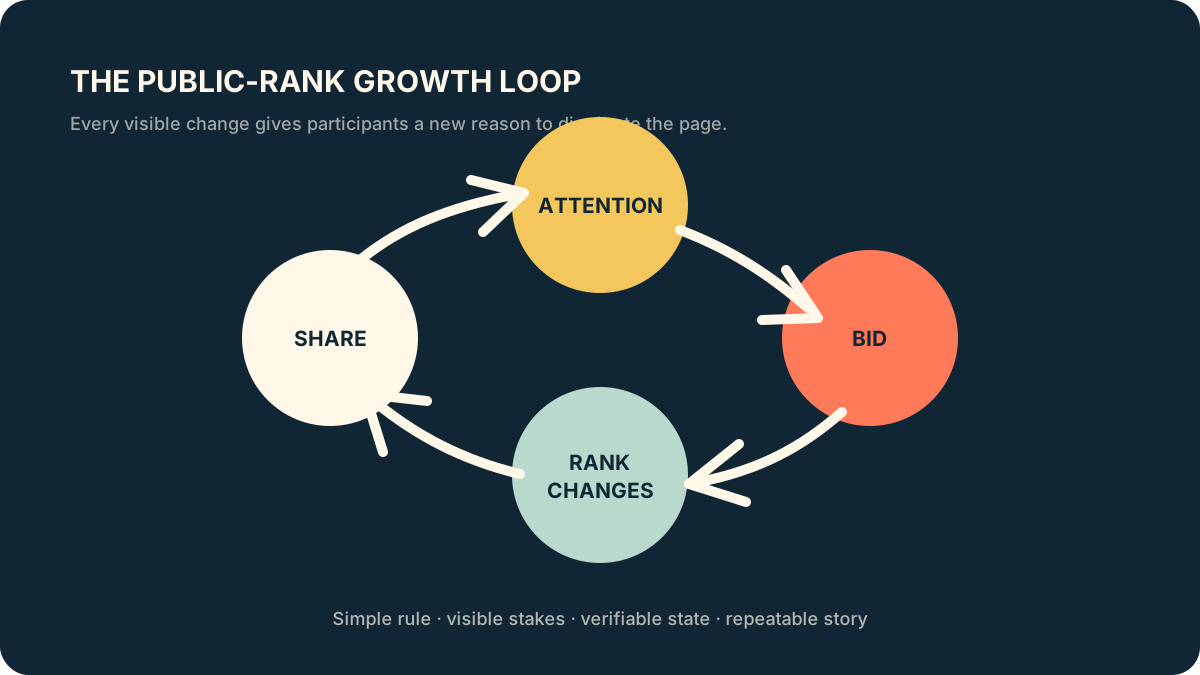
That creates a loop:
- A project buys or receives a boost.
- Its team shares the visible rank.
- New visitors discover both the project and the board.
- A rival or supporter responds with another bid.
- The changed board creates a new reason to share.
The loop is stronger than a static directory listing because the state can change. Movement makes the screenshot worth posting again.
3. Public money turns ranking into a spectator event
Many ranking products hide their formula. Outbid LOL makes the principal score legible. The number is not necessarily a measure of product quality, but it is easy to verify and discuss.
Money adds stakes. A one-dollar change can represent defense, ambition, humor, or provocation. People who never intend to pay can still follow the contest, visit entries, and debate whether the top position is worth it. The board therefore serves buyers and spectators at the same time.
4. The site produces its own proof
A live leaderboard is a continuously updated case study. Revenue totals, bid changes, click counters, and ranking history can become evidence that the mechanism is active. This is different from a landing page that claims “thousands of users” without showing the underlying behavior.
Transparent proof must be designed carefully. A click counter should be described as outbound activity, not unique people. A paid total should reflect successful, verified transactions, not canceled sessions. Any headline revenue figure should specify whether it means gross payments, net revenue, refunds, taxes, or fees.
The press hook: simplicity plus an extreme outcome
The articles around Outbid LOL commonly use a contrast: a “dead-simple” website paired with a very large reported outcome in a short period. Contrast makes a headline portable. Readers want to know how something so small could create so much attention.
Founders can learn from the narrative without copying the claim. Good launch stories include:
- a clear start date;
- a measurable before-and-after state;
- specific decisions, not only celebration;
- screenshots or public records;
- mistakes, constraints, and controversy;
- a result that can be independently understood.
5. Low-friction checkout keeps the story moving
A viral product loses momentum each time it asks for another decision. Mandatory registration, email verification, a dashboard tour, and a complicated package selector would all interrupt the impulse created by the leaderboard. Stripe guest checkout allows the visitor to move from a public quote to a familiar hosted payment page without first creating a local identity.
This does not mean trust controls should disappear. The amount still needs server-side validation, Stripe still handles card authentication, and fulfillment still waits for a signed webhook. The lesson is that risk controls can sit behind a short customer path. The customer sees a destination, contribution amount, resulting total, and checkout; the operator keeps idempotency, receipts, rate limits, and a billing trail in the background.
6. The smallest transaction creates a commitment
Reading a board is passive. Paying even a small amount turns a spectator into a participant with something to monitor. The first contribution does not need to be large because the product's purpose is immediately visible. Once a project appears, its team has a stronger reason to return, share the rank, and consider a later boost.
This is sometimes called a commitment loop, but it should not be confused with manipulative pricing. A responsible version shows the exact one-time charge and lets buyers stop at any time. The useful design principle is to make the first meaningful action affordable, reversible in attention, and easy to understand—not to hide the eventual cost.
7. Search demand follows the social event
When people encounter a strange viral product through X, a newsletter, or a screenshot, many do not visit it immediately. They search later. Their questions form a predictable ladder: “Outbid LOL,” “what is Outbid LOL,” “how does Outbid LOL work,” “why is Outbid LOL viral,” and “Outbid LOL alternative.”
A single leaderboard rarely answers all of those intents. Useful explainers can. The best pages define the mechanism, distinguish reported claims from verified facts, show examples, answer payment questions, and link to primary rules. That is why search coverage should be built around distinct questions instead of four thin pages repeating the same introduction.
Branded search demand can fade after a launch, so each article also needs lasting usefulness. A guide to campaign budgeting, guest payment support, or pay-to-rank economics remains valuable even when the original trend cools.
A closer look at the four reinforcing loops
The viral outcome is easier to understand as a system than as one lucky post:
- Comprehension loop: visitors understand the rule quickly, so more of them stay long enough to inspect the board.
- Transaction loop: a small public contribution changes the product state, making participation tangible.
- Distribution loop: participants share their new position, delivering new visitors without the operator buying every impression.
- Narrative loop: visible bids and movement produce numbers and conflict that writers can turn into a story.
Each loop feeds the others. Fast comprehension increases the number of potential participants. Transactions create visible proof. Proof makes sharing and coverage more credible. Coverage brings new spectators back to the first screen.
The loops also reveal likely failure modes. If checkout amounts are confusing, the transaction loop weakens. If rankings update unreliably, public proof loses credibility. If listing pages are not shareable, participants distribute less. If the operator overstates numbers, coverage can turn into distrust.
What to measure after the launch spike
Page views alone cannot show whether the mechanism is healthy. A useful operating dashboard separates board views, quote starts, Stripe Checkout opens, completed payments, webhook fulfillment, new listings, repeat boosts, outbound clicks, and destination conversions. Guest and signed-in journeys should be compared because they remove different amounts of friction.
The team should also watch concentration. If nearly all payment volume comes from two rivals, the revenue headline may be strong while the market is narrow. Repeat contributors, median contribution, the percentage of listings receiving a second boost, support contacts, disputes, and traffic retained after seven or thirty days provide a more durable picture.
Could the same playbook work again?
The exact novelty cannot be copied indefinitely. Once audiences recognize a format, a clone without a new angle becomes less surprising. A second product needs a distinct community, rule, data layer, or utility. Category-specific competitions, time-boxed seasons, public performance reports, community-funded entries, or better analytics can change the reason to participate.
The transferable skill is designing a public state that matters to users and changes through a simple action. Outbid LOL used money and rank. Another product might use verified completions, community votes with anti-abuse controls, speed, or collaborative progress. The mechanism should fit the audience rather than merely resemble a trending homepage.
What should not be copied
Copying a logo, wording, color system, domain confusion, or invented revenue number does not reproduce the growth loop. It creates legal and trust risk while removing the only durable advantage: a distinct reason to exist.
A better adaptation changes at least one meaningful axis. It might offer clearer payment support, cumulative boost explanations, public click counts, regional boards, category rankings, moderation history, or buyer analytics. BidLOL focuses on a transparent quote, guest checkout, verified fulfillment, and a support trail.
The durable SEO lesson
Virality and search traffic are different systems. A viral launch produces branded queries such as “what is Outbid LOL,” “how does Outbid LOL work,” and “why did Outbid LOL go viral.” Sites that answer those follow-up questions with useful, indexable pages can capture demand after the social spike.
That means the leaderboard should be supported by original explainers, stable detail pages, internal links, Article and FAQ structured data, a sitemap, and accurate titles. The content must satisfy the question rather than repeat the keyword mechanically.
Outbid LOL went viral because the product, payment, competition, and story reinforced one another. The reusable lesson is not “build the same board.” It is to design a product state people can understand, verify, change, and share.
Next, read how to use a pay-to-rank leaderboard without confusing buyers.
Research note
This analysis compared the original Outbid LOL about page with independent explainers from Generative AI and OutbidLOL.net. Third-party traffic, revenue, timing, and acquisition claims are treated as reported claims rather than audited facts. The growth-loop interpretation and recommendations above are BidLOL's original analysis.