OUTBID LOL
Outbid LOL Economics: What the $100K Story Teaches Founders
A sober look at reported Outbid LOL revenue, auction dynamics, gross versus net revenue, demand decay, trust, and durable product lessons.
The most repeated Outbid LOL headline is not about interface design. It is the reported claim that a very simple website generated roughly $100,000 in less than 48 hours. Whether a specific number is gross payments, net revenue, or a snapshot from a third-party dashboard matters. A founder should treat external articles as reports until primary records and definitions are available.
Still, the story raises a useful question: what kind of economics can make a tiny pay-to-rank product produce a large number quickly?

A leaderboard sells a scarce relative position
Traditional advertising sells a defined unit: impressions, clicks, or time. A pay-to-rank board sells a relative position whose price depends on other buyers. The first entry may cost only a few dollars. Once several motivated projects compete, the amount required to reach number one can rise without the operator manually changing a price list.
This resembles an auction, but it is not a standard winner-takes-all auction. Earlier payments remain visible in cumulative totals, lower-ranked listings still receive exposure, and participants can return with incremental boosts. The board monetizes both entry and rivalry.
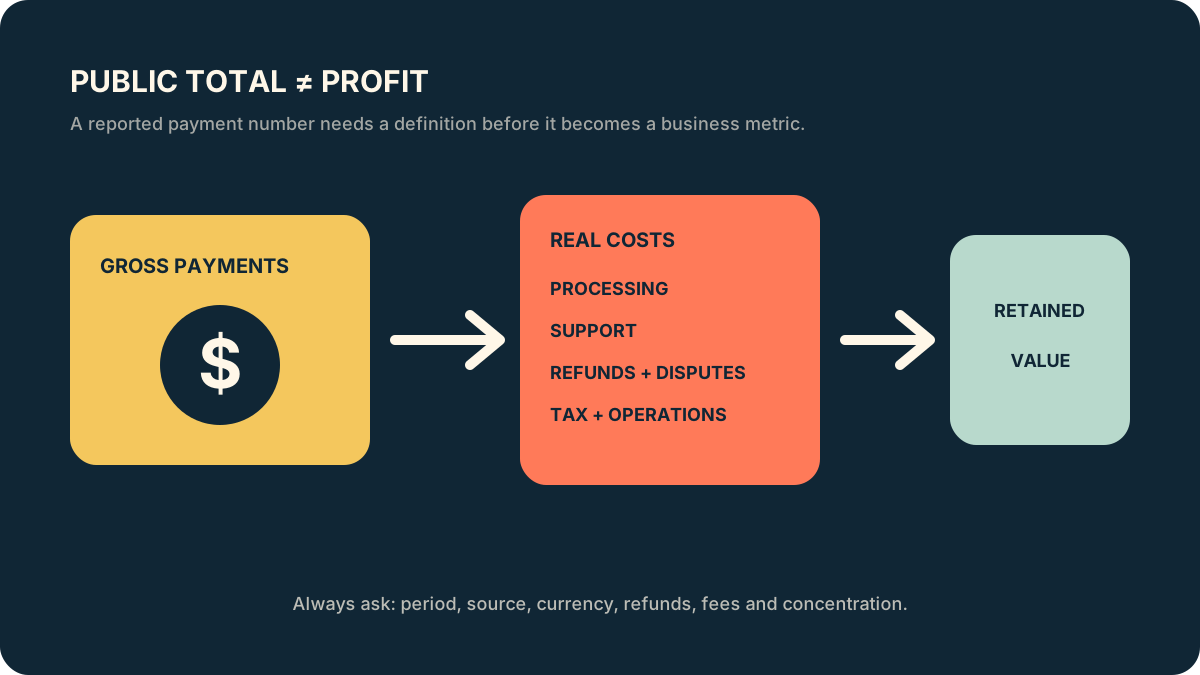
Gross payment is not the same as profit
A dramatic revenue counter can hide several deductions:
- payment processing fees;
- refunds and disputes;
- taxes and compliance costs;
- infrastructure and support;
- fraud losses or reserves;
- affiliate or partner shares, if any.
If a site reports “$100K,” the useful follow-up questions are: over what time period, measured by which provider, before or after refunds, and including which currencies? Precision improves credibility; it does not weaken the story.
Why demand can rise so quickly
The price of a top position is connected to expected attention. Early participants may bid because the site is going viral. Their bids create a larger visible number, which makes the board more newsworthy, which attracts more visitors, which can make the position feel more valuable.
That is a reflexive loop:
attention → expected placement value → bids → public proof → more attention
Reflexive systems can grow quickly, but they can also reverse. When attention falls, a historic cumulative total may remain high while the present value of the placement declines. Buyers should judge current traffic and campaign fit, not assume that an old top price guarantees future results.
Cumulative totals create both retention and risk
Cumulative bidding gives an existing project a reason to return. It pays only the new increment, not its entire historical total. Supporters may also contribute, turning the listing into a shared public object.
But cumulative totals can anchor expectations. A new entrant may see a high first-place amount and leave. The operator must balance excitement at the top with accessible value lower on the board. Public click counts, detail pages, categories, or time-based views can help lower positions remain useful.
Trust is part of the economic model
The board's numbers are the product. If canceled payments appear, duplicate webhooks add money twice, or hidden fees change the Stripe charge, the market loses its reference point.
That is why seemingly technical details become commercial infrastructure:
- server-side amount calculation prevents client tampering;
- Stripe-signed webhooks verify fulfillment;
- idempotency prevents a retry from double-counting;
- stable tie rules avoid arbitrary reorderings;
- normalized URLs stop duplicate listings;
- receipts and transaction references provide support evidence;
- sponsored link labels describe the placement honestly.
A trustworthy smaller number is more valuable than an inflated number nobody believes.
What founders should actually copy
The durable lessons are structural:
Price around visible value
The buyer can see the position, amount, and activity. The product does not require an enterprise sales call to explain the unit.
Make the state shareable
A changed rank gives participants a reason to distribute the product again.
Keep the first transaction small
A low minimum lets curiosity become a real transaction. Larger amounts emerge from competition rather than a high initial barrier.
Publish the rules before the payment
The charge, cumulative total, tie behavior, refund path, and sponsored nature of the link should be visible before checkout.
Build support into a guest flow
Reducing registration friction is valuable only when a guest can later locate a payment and resolve a problem.
What the headline cannot tell you
A 48-hour spike says little about retention, repeat buyer concentration, organic search durability, dispute rate, or long-term placement value. Those metrics determine whether the launch becomes a business or remains a memorable event.
For an operator, the next dashboard should separate:
- visitors and unique buyers;
- guest and signed-in checkout conversion;
- new listings and existing-listing boosts;
- gross payment volume and net retained revenue;
- outbound clicks by rank;
- repeat buyers and support contacts;
- refunds, disputes, and failed checkout attempts.
The Outbid LOL story is compelling because the mechanism can turn attention directly into an escalating public number. The founder lesson is to combine that energy with measurement, support, truthful definitions, and a reason for users to return after the headline fades.
Read why the growth loop worked or see the transparent BidLOL board.
A simple unit-economics model
Consider a hypothetical $10 contribution. Stripe processing takes a fee, the operator may owe tax, and a small portion of transactions may later be refunded or disputed. What remains is contribution margin before fixed costs such as engineering, moderation, accounting, and customer support. The public $10 total should still show the verified amount paid under the rules; it is not a claim that the operator kept $10 as profit.
At the marketplace level, four variables matter:
- the number of visitors who request a quote;
- the percentage who open and complete checkout;
- the average contribution and repeat-boost rate;
- the cost of acquiring, serving, moderating, and supporting those transactions.
A viral spike can make acquisition cost appear close to zero, but that does not automatically persist. Once social distribution slows, content, community, partnerships, or paid acquisition may be needed. The sustainable question is whether expected gross margin from a visitor exceeds the cost of bringing and supporting that visitor without weakening trust.
Why rank liquidity matters
An active board needs enough buyers to create movement but not such a high top price that every newcomer leaves. Economists might describe this as liquidity: participants should believe that positions are attainable, observable, and capable of changing.
Several product choices affect that liquidity. A low minimum opens the bottom of the board. Incremental boosts reduce the cost of returning. Visible click activity gives lower positions a possible benefit. Clear tie rules reduce uncertainty. Categories or time windows can create additional competitive surfaces when one global board becomes too expensive.
The operator should resist manufacturing activity. Fake listings or simulated bids may make a board look busy briefly, but they corrupt the price signal that buyers are paying to observe. Honest cold starts are slower and much easier to defend.
Revenue concentration and competitive whales
An exciting total can be dominated by a handful of buyers. Two well-funded projects repeatedly passing each other may generate most of the payment volume while hundreds of other listings contribute little. That concentration is not automatically bad, but it creates volatility and support risk.
Useful concentration measures include the share of gross volume from the top one, five, and ten buyers; the share from repeat boosts; median versus mean contribution; and the number of independent destinations paying in a week. A board with a healthy long tail is less dependent on one rivalry continuing forever.
Operators should also avoid designing dark patterns specifically to provoke unlimited defense spending. A clear one-time amount, no automatic rebidding, visible rules, and an easy stopping point preserve the entertainment of competition without turning confusion into revenue.
Refunds, disputes, and the cost of guest convenience
Guest checkout removes account friction, but it moves identity work into email receipts and support. The operator must connect each Stripe Checkout Session to a bid intent, listing, amount, and fulfillment record. When a buyer asks for help, staff need to locate the transaction without requesting unsafe card details.
Dispute evidence is stronger when the checkout description, terms, destination, timestamp, IP-derived risk signals where lawful, webhook event, and public fulfillment record agree. This is another reason the checkout amount and the cumulative listing total must be shown as separate concepts. A buyer disputing a $5 charge should not encounter a receipt that looks like a $17 purchase merely because the listing became worth $17.
The value and limitation of public click counts
Clicks help a buyer judge whether attention reaches listed projects. They also make the board more informative for spectators. Yet raw counts can be noisy: bots, repeat visits, link previews, and privacy systems all affect measurement. A click is not a unique person and certainly not revenue for the destination.
For economics, the best analysis pairs the board's redirect count with destination-side sessions and conversions. If a $20 boost produces 40 recorded outbound events, 28 destination sessions, 6 sign-ups, and one customer, each stage tells a different part of the story. The board should report only the stage it actually observes.
Scenarios after the viral peak
Three broad outcomes are possible. In the first, the board stays culturally relevant and fresh competition keeps the global ranking active. In the second, the viral brand fades but search content and niche communities provide a smaller, durable stream of participants. In the third, attention collapses and the historic top totals become a museum of the launch.
Durability improves when the product creates reasons to return that are not solely based on novelty: campaign analytics, listing histories, time-based seasons, category views, new-project discovery, community events, or useful editorial analysis. Each feature should preserve the transparent core rather than bury it under a conventional ad platform.
A founder's due-diligence checklist
Before treating an Outbid LOL revenue story as a blueprint, ask:
- Is the quoted number gross processed volume, recognized revenue, or profit?
- What portion came from the largest buyers?
- How much was later refunded or disputed?
- How many buyers returned independently?
- Did listed projects receive valuable traffic or only spectacle?
- Which acquisition channels remained after the viral article stopped circulating?
- What operational work was required for moderation and payment support?
The answers do not make a simple product less impressive. They explain which part of the result came from product design, which came from a temporary distribution event, and which might be reproducible in another market.
Sources and claim standard
The widely repeated launch figure discussed here appears in third-party coverage, including Generative AI's account. Product mechanics were cross-checked against the original Outbid LOL about page. These links are provided for context; BidLOL cannot independently audit another operator's Stripe records, acquisition discussions, traffic analytics, refunds, or tax treatment. The economic model in this article is illustrative, not a statement of the original site's profit.